Stone or Timber Gateposts for a Garden Gate?
Stone or timber gateposts shape a garden entrance differently. Compare their character and routine upkeep to choose a material that suits its setting.
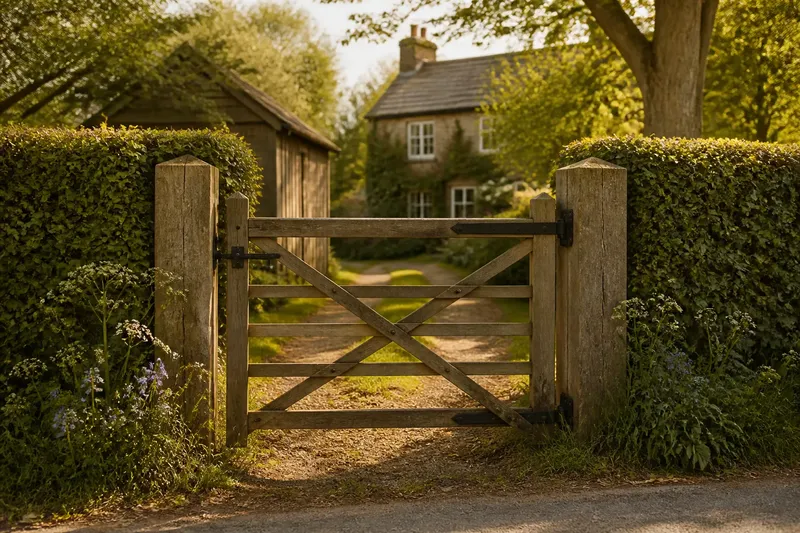
Stone or timber gateposts can make the same garden gate feel settled, spare, or conspicuously grand. If you are choosing between them, start with the view from the lane: what should the entrance belong to, and how much attention should its posts demand?
Begin with the gate and its surroundings
Gateposts are not isolated ornaments. Their height, width, surface, and color sit beside the gate itself, the boundary hedge or fence, the approach, and the buildings beyond. A material that feels convincing in one setting can look imported into another.
Stone tends to read as weight and continuity. Rough fieldstone can echo a low wall or rocky ground; neatly dressed stone makes a more deliberate, formal entrance. Timber looks lighter and more changeable. Weathered oak or chestnut can sit comfortably with hedges, pasture gates, and timber outbuildings, while a freshly painted post may draw the eye to the joinery rather than the landscape.
Neither material is automatically more rural. The useful question is whether the posts appear to continue an existing local vocabulary or introduce a new one. Look at nearby walls, gate hardware, sheds, and boundary repairs, not just the most picturesque building in sight.
A hypothetical lane-side garden clarifies the choice
Say you have an invented, hypothetical situation: a garden opens onto a quiet lane through a clipped hedge, with a simple wooden gate and a modest stone cottage set back among trees. The current posts are narrow, dark timber, and the gate looks slightly undersized between them. You want the entrance to feel more settled without turning it into a monument.
First, you stand at the lane and notice that a low stone wall already runs along one side of the drive, but the hedge remains the main boundary. Replacing the posts with large, carefully cut stone would extend the wall’s visual language too forcefully. It could make the gate read as a formal threshold rather than an opening in a hedge.
Then you compare timber options. Chunkier, naturally finished posts would give the gate a clearer frame while keeping the entrance visually light. The grain and eventual weathering would relate to the nearby outbuilding. In this imagined case, timber is the better fit, not because it is universally easier, but because it strengthens what is already there without changing the character of the approach.
The expected observable result is modest: the gate becomes easier to read from the lane, while the hedge and cottage remain the dominant features. If the same invented garden instead had a substantial stone boundary and a broad, formal entrance, stone posts might carry the existing composition more naturally.
Stone brings visual weight and surface variation
Stone posts can be built from local-looking rubble, squared blocks, or a combination of a solid base and a simpler cap. Their color and texture may connect a gate to an existing wall even when the construction is not identical. Small differences in stone face and joint can give a post a less manufactured appearance.
That visual weight has consequences. A pair of broad stone piers can dominate a light gate, narrow-looking path, or low hedge. A heavily patterned stone may also compete with a cottage facade that already has varied masonry. For a restrained entrance, simpler profiles and quieter surfaces are usually easier to place than elaborate caps or contrasting bands.
Ordinary upkeep is often about noticing change rather than routine coating. Watch for loose or damaged joints, movement, water collecting on ledges, and vegetation taking hold in cracks. The appropriate repair depends on the stone and the existing mortar; a mason familiar with local materials can help where the work is substantial. Avoid treating every patch or mark as a fault. Stone is allowed to look like stone.
Timber keeps the entrance lighter but asks for attention
Timber posts suit a gate whose appeal comes from straightforward joinery, a hedge, or a working boundary. Their proportions can be adjusted without adding much visual mass, and their color can blend with a gate or distinguish it gently. A plain, substantial post often looks more at home than one dressed up with finials that have no counterpart nearby.
Timber changes as it weathers. Depending on the species, finish, exposure, and ground conditions, it may fade, develop surface checks, or show wear near the base. Regularly look for soft or damaged areas, standing water, loose fixings, and peeling coating if the posts are painted or treated. Keep soil, leaves, and dense plants from concealing the point where each post meets the ground.
Some owners accept a muted, weathered finish; others prefer to maintain a painted or stained surface. Either choice brings a different rhythm of attention. The relevant label, manufacturer instructions, and local rules determine any treatment or installation details.
Stone or timber gateposts suit which setting?
Which material looks right beside a hedge?
Timber usually keeps a hedge-led entrance visually light, especially with a simple wooden gate. Stone can also work where a nearby wall or exposed stone in the setting gives it a clear reason to be there.
Which posts need more routine attention?
Timber generally calls for closer attention to surface condition, coatings, and the base where moisture can linger. Stone usually asks for checks on joints, movement, and water-catching details rather than periodic surface finishing.
Can stone and timber be used together?
Yes, a stone base with timber above can connect a wall to a lighter gate. It works best when the transition looks intentional and the materials already have a relationship elsewhere in the boundary.
What should matter most when choosing?
Start with the gate, boundary, and view from the public approach, then consider the upkeep you are willing to make ordinary. A striking material is not an improvement if it makes the entrance feel unrelated to its setting.
Choose for the whole view, not the sample
A small sample of stone or a timber offcut can mislead: it shows surface color, not how a pair of posts will frame a gate against a hedge or wall. If possible, compare the proposed material from the lane and from inside the garden. Check it in both sun and dull weather, when texture and contrast read differently.
It is not worth the effort to chase an exact match to every nearby stone or timber surface. A close imitation can look more self-conscious than a quiet, compatible choice. Aim instead for a shared quality: similar roughness, a related tone, or a comparable level of formality.
For stone or timber gateposts, the sound choice is the one that supports the entrance already present and fits the kind of upkeep you will actually do. In the lane-side example, heavier stone would have made a modest hedge opening announce itself; timber gave the gate a clearer frame while leaving the garden’s existing character in charge.