A Rainy-Day Reading of an Old Shopfront
A rainy-day reading of an old shopfront helps you notice lettering, entrances, window divisions, and repairs while keeping guesses about its history in check.
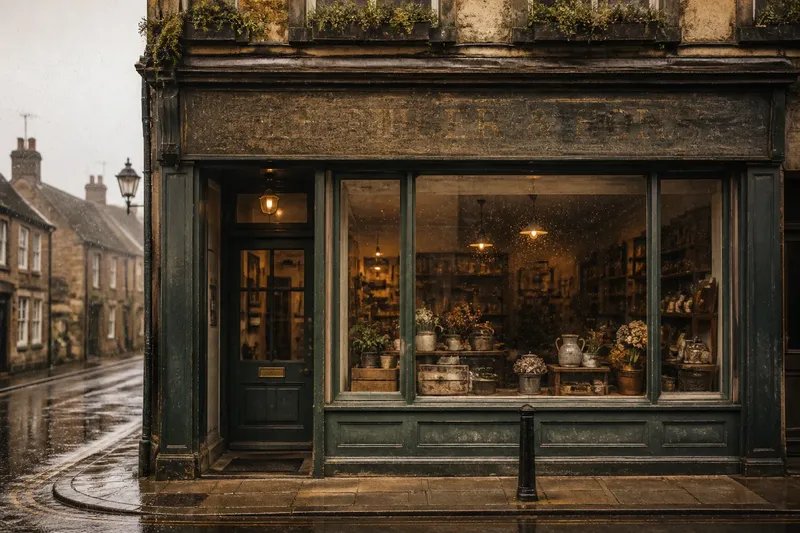
What can a rainy-day reading of an old shopfront tell you without turning a passing glance into a theory about its age? Start with the lettering, the way the entrance shelters people, and the pattern of the windows. Rain makes edges and changes in surface easier to see; it does not provide a date or explain why something was altered.
Stand on public ground where you can see the whole frontage without blocking the doorway. Read its parts as a working arrangement: a sign identifies the business, windows display goods or reveal the interior, and the entrance connects the shop to the street. Then consider how weather changes what is visible.
Read the lettering as part of the frontage
Look first at the shop name, then at smaller words on the glass, such as opening hours or a trade description. Note how each is made: painted directly on glass, fixed to a board, assembled from individual letters, or printed on a temporary notice. These methods put words at different distances from the wall and give them different visual weight.
Consider the sign in relation to the doorway and windows. A board above the entrance may cast a narrow shadow; lettering on glass may preserve a broad view inside. A centered sign can anchor the facade, while a second line may compete with the name. The useful question is whether a passerby can read the business and whether the sign sits comfortably among the other parts.
Rain can darken the wall around an old sign or reveal a faint boundary where a covering once sheltered the surface. That boundary records a difference in exposure, not the words or date of a former sign. Treat it as a visible mark rather than a complete account of what came before.
Notice how the entrance meets the street
The entrance is a working threshold, not just a composition. Look at the door’s position, the depth of any recess, and the way an awning or canopy sheds rain. A recessed doorway offers a place to pause out of the weather; a flush entrance makes a more direct transition from pavement to shop.
Hardware and wear can show where people make contact. A polished handle suggests frequent use, while scuffs near the bottom of a door may come from ordinary traffic. Neither mark establishes how long the door has been there. Color, glazing, and frame shape help show whether it relates visually to the surrounding windows, but they cannot tell you the owner’s intention.
At ground level, notice the threshold, mat, drain, or paving change. A wet patch may result from water running along the pavement or dripping from an awning, so it does not identify a building problem by itself. Leave the entrance clear, and do not test a door or enter a private recess to improve your view. For accessibility or building-condition concerns, ask a qualified professional.
Follow the window divisions
Trace the vertical mullions, horizontal rails, and frames around the door. Broad panes create a different rhythm from narrow divisions. Check whether the window lines align with the entrance, the sign, or the upper facade; those relationships can make parts from different periods feel like one arrangement.
Rain turns glass into a reflective surface while often leaving its divisions easy to follow. Notice which sections are clear, frosted, lettered, or filled with display goods. A window that shows the shop interior communicates differently from one arranged as a display, and both choices serve practical purposes as well as visual ones.
At the edges, a mismatched pane, fresh sealant, or different frame finish may indicate separate repairs. Those details tell you that components do not all look alike; they do not establish when the work took place or whether the whole frontage is old.
Say you are looking across a wet village street at a shop with one broad central pane, two narrow side panes, and a door at one end. If the side panes and door share a frame color, you can describe them as visually connected. If the door is a contrasting color, you can note that it stands apart. Neither observation proves when the door was installed or why someone chose that color.
What can rain reveal about a shopfront?
Does a faded sign mean it should stay?
No. Fading may leave a visible trace, but it can also make a business difficult to identify or accompany a surface in poor condition. Consider legibility, material, and the sign’s relationship to the wall before treating age as a reason to retain it.
Can rain identify a shopfront’s materials?
It can suggest differences: glass reflects, painted wood may darken unevenly, and metal can show contrasting patches. Dirt, coatings, repairs, and reflected light complicate appearances, so do not name a material from a street view when the identification matters.
How should I photograph a shopfront?
Use a public viewpoint and frame the sign, entrance, and window pattern together if you want to remember how they relate. Avoid including identifiable people or aiming through the glass at customers and staff; a photograph of the facade should not turn the shop into a display case.
Keep visible details separate from claims about age
A dark timber frame may look original, a patch beneath a sign may resemble the outline of a former board, and a narrow doorway may suggest an earlier arrangement. Each is a reason to look more closely, not proof of a date or past use. Describe what is visible—worn paint beneath the sign, for instance—without extending it into a story about how long the same business has occupied the building.
- If lettering is clear from the pavement, note that it identifies the business; if it is hard to read, consider whether larger or simpler lettering would help.
- If a sign sits out of line with the entrance and windows, note the mismatch; if it disrupts the frontage, consider repositioning it before changing the facade.
- If a door’s color and frame relate to nearby windows, describe the visual connection; if they contrast sharply, consider whether the contrast is intentional before repainting.
- If rain collects beside the threshold, record where it gathers; if the cause matters for access or building condition, ask a qualified professional rather than inferring it from one view.
- If a pane or sealant differs from its neighbors, note the repair; if you need to know its age or material, seek an informed assessment rather than guessing from appearance.
- If a photograph includes customers or reveals private interior activity, change the angle or leave the camera away; if the view cannot exclude them, rely on written notes instead.
It is not worth assigning a date to every hinge, pane, or paint layer during a passing look. A short record of what aligns, what differs, and what rain brings into view is more useful than a chronology assembled from clues with several possible explanations.
For a rainy-day reading of an old shopfront, the most useful record is modest: the sign’s position, the entrance’s relation to the windows, the pattern of the panes, and any visible repairs. If you return in dry weather, compare those same features. You will have a clearer account of how the frontage works, without asking a wet patch or faded letter to explain more than it can.